



Ocd treatment in sacramento at Vantage Point

OCD Treatment in Sacramento at Vantage Point

At Vantage Point, we provide specialized, evidence-based treatment for Obsessive-Compulsive Disorder (OCD). Our therapists are trained in gold-standard approaches, including Cognitive Behavioral Therapy (CBT), Exposure and Response Prevention (ERP), and Acceptance and Commitment Therapy (ACT).

Treatment is tailored to your unique symptoms, values, and goals. Rather than trying to eliminate intrusive thoughts, we help clients learn new ways to respond to them—reducing the cycle of fear, avoidance, and compulsive behaviors so they can regain a sense of freedom and control in their lives.

Our team is committed to providing compassionate, structured, and effective care for OCD in all its forms.

Person sitting thoughtfully, representing the experience of intrusive thoughts and OCD

OCD Treatment Options

Psychotherapy
The primary treatment for OCD is psychotherapy, particularly ERP-based CBT. Therapy focuses on gradually facing feared thoughts or situations while learning to resist compulsive responses.

Medication
Some individuals benefit from medication, often SSRIs or other anti-anxiety medications. Many people find the most effective approach is a combination of therapy and medication.

At Vantage Point, we collaborate with trusted psychiatrists in the community and can help facilitate referrals when medication is part of your treatment plan.

Therapist and client in a therapy session discussing OCD treatment options in Sacramento

Understanding Obsessions and Compulsions

Obsessions are intrusive, unwanted thoughts, images, or urges that cause significant anxiety or distress. These thoughts are not simply excessive worries about everyday concerns and often feel out of character or alarming.

Compulsions are repetitive behaviors or mental rituals performed to reduce anxiety or prevent a feared outcome. While compulsions may bring temporary relief, they ultimately reinforce OCD and keep the cycle going.

Compassionate therapy environment for specialized OCD-related condition treatment in Sacramento

Specialized OCD-Related Conditions We Treat

Hoarding Disorder
Treated using CBT, skills training, and motivational interviewing to support decision-making, organization, and reduced clutter.

Trichotillomania (Hair-Pulling Disorder)
Treated with CBT approaches that help identify triggers and develop healthier replacement behaviors.


Common OCD Symptoms

Obsessions may include:

01

Fear of contamination, illness, or harming others

02

Doubts about mistakes or whether tasks were completed correctly

03

Intrusive thoughts related to violence, sex, religion, or morality

04

A strong need for symmetry, exactness, or things feeling “just right”

05

Fear of doing something embarrassing, immoral, or unsafe

06

Persistent fear of being responsible for harm, such as causing an accident, making someone ill, or being blamed for something going wrong

Compulsions may include:

01

Excessive hand washing or cleaning rituals

02

Repeated checking (locks, appliances, emails, belongings)

03

Mental rituals such as repeating phrases, prayers, or “good” thoughts

04

Reassurance-seeking from loved ones

05

Avoidance of people, places, or objects that trigger distress

06

Seeking reassurance repeatedly from others


ocd groups at vantage point
01

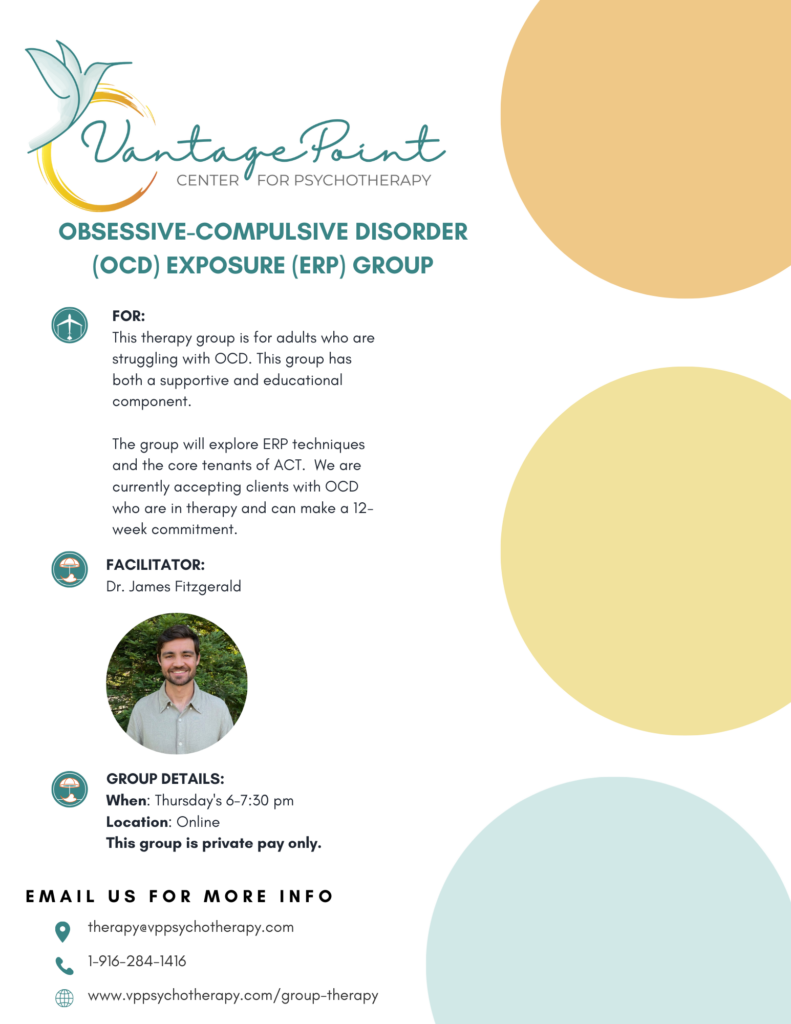
ocd exposure group

This group is designed for adults with OCD who are ready to actively work on reducing symptoms through Exposure and Response Prevention (ERP). Combining practical skill-building with supportive guidance, participants will learn how to face fears, reduce compulsions, and build confidence over time. A 12-week commitment is required, and participants must be engaged in individual therapy.

james group posterfinal
kelly group posterfinal

02

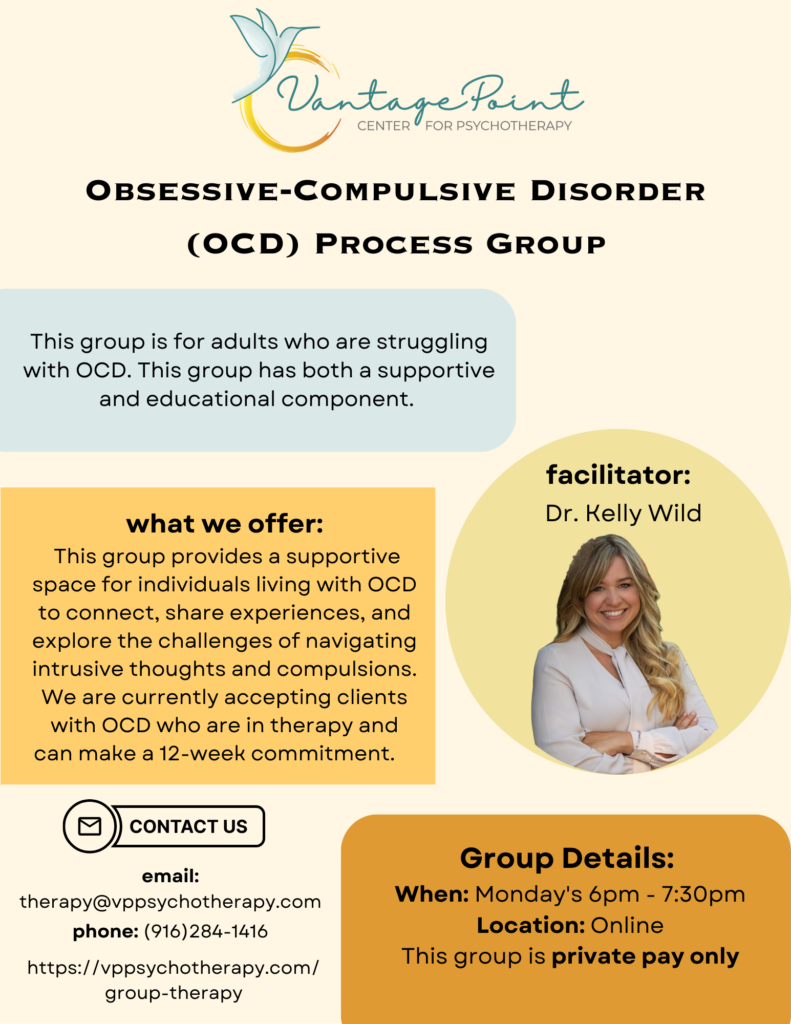
ocd process group

This supportive and educational group is for adults living with OCD who want a space to connect, share experiences, and better understand their symptoms. Together, participants explore the challenges of intrusive thoughts and compulsions while building insight, community, and coping strategies. A 12-week commitment is required, and participants must be in individual therapy.


Frequently Asked Questions

What is OCD and how is it different from being ‘a little OCD’?

OCD (Obsessive-Compulsive Disorder) is a clinical anxiety disorder involving intrusive, unwanted thoughts (obsessions) and repetitive behaviors or mental rituals (compulsions) performed to reduce distress. It causes real impairment in daily functioning — often taking hours out of a person’s day. This is very different from colloquially “liking things neat” or “being particular.” A formal OCD diagnosis involves significant distress and interference with work, relationships, or daily life.

What is ERP and why is it the recommended treatment for OCD?

Exposure and Response Prevention (ERP) is the gold-standard, evidence-based treatment for OCD. It works by gradually exposing a person to feared thoughts or situations while helping them resist the urge to engage in compulsions. Over time, the brain learns that anxiety decreases on its own without rituals. ERP has the strongest research support of any OCD treatment and is recommended by the IOCDF and APA.

Does Vantage Point treat all subtypes of OCD?

Yes. Our clinicians have experience with a wide range of OCD presentations, including contamination OCD, harm OCD, religious/scrupulosity OCD, relationship OCD (ROCD), symmetry/order OCD, and Pure-O (primarily obsessional OCD). If you are unsure whether your experience fits OCD, we can help clarify that through the intake and assessment process.

How long does OCD treatment take?

Most clients begin to see meaningful improvement within 12 to 20 sessions of ERP-based therapy, though this varies depending on OCD subtype, severity, and how long symptoms have been present. Some clients continue treatment longer to address additional themes or to work on relapse prevention.

Is Vantage Point an APA-accredited practice?

Yes. Vantage Point Center for Psychotherapy is the only non-academic APA-accredited psychology internship training site in the greater Sacramento area. This means all clinical work is conducted under rigorous supervision that meets national APA standards for psychological practice and ethics.

Do you offer OCD treatment in Spanish?

Yes. We have Spanish-speaking clinicians available for clients who prefer to receive therapy in Spanish.


Taking the First Step

Getting started is simple. Complete our Client Intake Form, and a member of our team will reach out within two business days to help match you with a therapist who fits your needs.

Scroll to Top