Neuropsychological Assessment in Sacramento
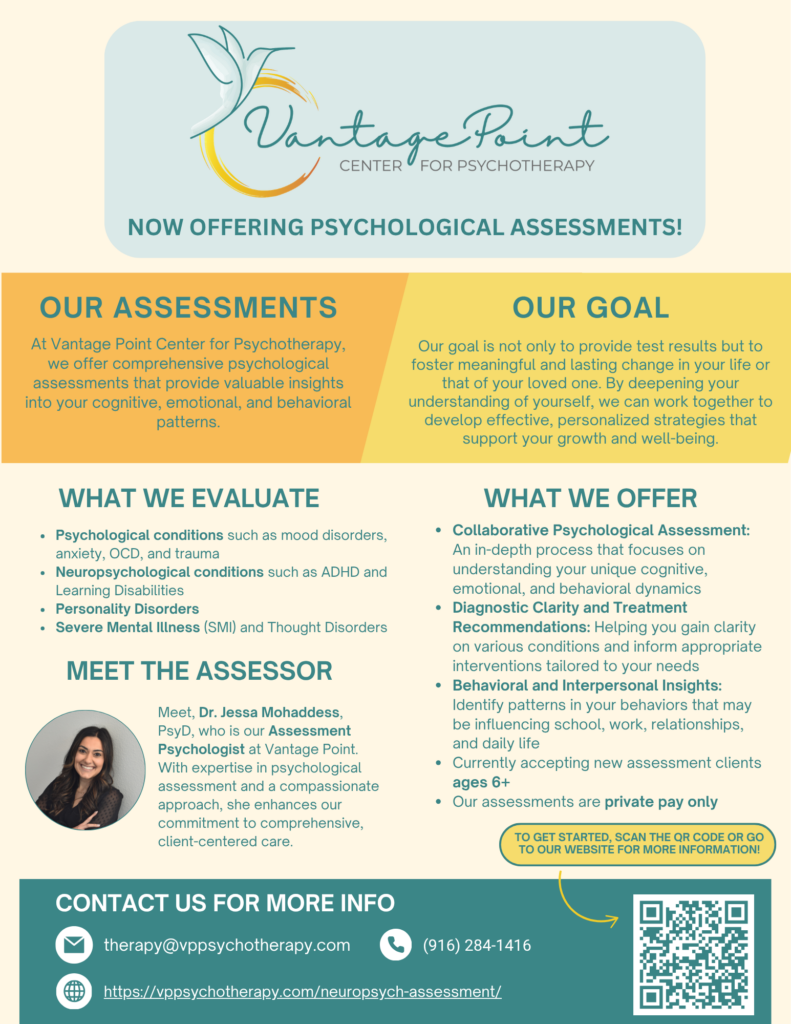
A neuropsychological evaluation is a comprehensive assessment that measures how a person processes information and identifies the source of any difficulties. Whether you are a child struggling in school, a college student navigating a new diagnosis, or an adult seeking clarity on longstanding challenges, testing can provide meaningful answers. Areas evaluated include attention, memory, processing speed, reasoning, language, executive functioning, academic skills, and social-emotional functioning. Results help clarify diagnosis, guide treatment planning, and support accommodations at school or work.
What we test for
Our assessments can evaluate for:
Attention and ADHD
Executive functioning deficits
Learning disabilities (dyslexia, dysgraphia, dyscalculia)
Intellectual deficits or giftedness
Memory and cognitive functioning
Anxiety and OCD
Depression and mood disorders
Eating disorders
Personality disorders
Please note: we are not currently testing for autism spectrum disorders.
about our assessments
who should consider testing?
Testing may be helpful if you or someone you care about:
Struggles academically or professionally despite significant effort
Has difficulty with attention, focus, reading, writing, or math
Experiences memory concerns or cognitive changes
Has been told they are “lazy,” “unmotivated,” or “not trying hard enough” without a clear explanation
Wants a clearer understanding of their learning style or cognitive profile
Needs accommodations for standardized tests such as the SAT, ACT, MCAT, LSAT, GMAT, or GRE
Needs documentation for an IEP, 504 Plan, or workplace accommodations
Is an adult who suspects an undiagnosed learning disability or ADHD that has gone unaddressed for years
Personalized to You
Every evaluation is tailored to your age, concerns, and goals — no one-size-fits-all approach.
Clarity That Leads to Action
You’ll receive a thorough feedback session and written report with clear, actionable next steps.
A Trusted Sacramento Resource
The only non-academic APA-accredited training site in greater Sacramento, held to the highest clinical standards.
How Does The Testing Process Work?
Assessments at Vantage Point are individualized based on your age, referral concerns, and goals. A typical evaluation may include a clinical interview, review of relevant records, standardized testing, and a feedback session to review results and recommendations.
Cognitive Ability Testing
(e.g. WISC-V, WAIS-IV) Measures verbal and perceptual reasoning, working memory, and processing speed to build a picture of overall intellectual functioning.
Attention and Executive Functioning
Evaluates the ability to maintain focus, initiate tasks, regulate emotions, and stay organized — areas that often underlie challenges at school, work, or in daily life.
Academic Testing
Assesses reading fluency and comprehension, math calculation, written expression, spelling, expressive and receptive language, phonological processing, visual-motor skills, and auditory processing.
Memory and Learning
Evaluates the ability to learn and retain information across visual and auditory modalities, including both rote and complex material.
Social and Emotional Functioning
Assesses mood, coping, and self-concept through clinical interviews, projective measures, and objective and subjective rating scales.
Adaptive Functioning
Evaluates how effectively a person manages everyday tasks and independent living skills — including communication, self-care, and social interactions — across home, school, and work settings.
What is a Learning Disability?
A LEARNING DISABILITY IS A NEUROLOGICAL DISORDER WHICH AFFECTS THE BRAIN’S PROCESSING ABILITIES.
A learning disability is a neurological condition that affects how the brain processes information. It does not reflect intelligence — it means that a person processes certain types of information differently, which can lead to difficulties with reading, writing, spelling, or math.
Learning disabilities are often identified in childhood, but many go undiagnosed well into adulthood. For adults, an unidentified learning disability can affect academic performance, career trajectory, relationships, and self-esteem. A formal evaluation can provide long-overdue clarity and open the door to support and accommodations that make a real difference.
While learning disabilities cannot be cured, research-supported interventions and accommodations can significantly improve outcomes at any age.
Learning disabilities we evaluate for include:
- Dyslexia (reading disorder)
- Dysgraphia (disorder of written expression)
- Dyscalculia (math disorder)
- Visual-motor integration disorder
- Executive functioning deficits in working memory, time management, and organization
Our Assessment Coordinator
Dr. Jessa Mohaddess-Westmoreland, PsyD
Dr. Jessa Mohaddess brings expertise and warmth to her role as Assessment Coordinator at Vantage Point. She earned her doctorate in Clinical Psychology from the California School of Professional Psychology in Sacramento and completed an APA-accredited internship at Harvard Medical School/Cambridge Health Alliance. She joined Vantage Point as a postdoctoral fellow and provides comprehensive neuropsychological and diagnostic assessments for individuals ages 6 and up.
Frequently Asked Questions
What is a neuropsychological evaluation and what does it assess?
A neuropsychological evaluation is a comprehensive assessment that measures how a person processes information and identifies the source of any difficulties. Areas assessed include attention, memory, processing speed, reasoning, language, academic skills, executive functioning, and social-emotional functioning. Results help clarify diagnosis and inform treatment recommendations and academic accommodations.
Who performs neuropsychological assessments at Vantage Point?
Assessments at Vantage Point are coordinated by Dr. Jessa Mohaddess-Westmoreland, PsyD, who earned her doctorate in Clinical Psychology and completed an APA-accredited internship at Harvard Medical School/Cambridge Health Alliance. She provides neuropsychological and diagnostic assessments for individuals ages 6 and up.
What conditions can a neuropsychological evaluation diagnose?
Our assessments can evaluate for ADHD, specific learning disabilities (such as dyslexia, dysgraphia, and dyscalculia), executive functioning deficits, anxiety, OCD, depression, mood disorders, eating disorders, personality disorders, and memory and cognitive concerns. Please note that we are not currently testing for autism spectrum disorders.
Can testing help obtain accommodations for standardized tests or school?
Yes. Neuropsychological testing results can be used to support applications for academic accommodations including IEP and 504 Plans, as well as extended time or other accommodations on standardized tests such as the SAT, ACT, MCAT, LSAT, GMAT, and GRE.
How do I know if my child needs testing?
Testing may be appropriate if your child is struggling academically despite effort, has difficulty with attention, reading, writing, or math, experiences behavioral or emotional challenges at school, does not want to attend school, or has been described as “lazy” or “disobedient” without a clear explanation. An evaluation can clarify what is happening and guide meaningful support.
How do I schedule a neuropsychological evaluation at Vantage Point?
To get started, please complete our Assessment Intake Form, or call us at 916.284.1416. Dr. Mohaddess will review your intake and follow up to discuss next steps.
psychological testing neuropsychological evaluation Sacramento ADHD learning disabilities cognitive concerns
psychological testing neuropsychological evaluation Sacramento ADHD learning disabilities cognitive concerns