



ocd groups at vantage point
Frequently Asked Questions
What is OCD and how is it different from being ‘a little OCD’?
OCD (Obsessive-Compulsive Disorder) is a clinical anxiety disorder involving intrusive, unwanted thoughts (obsessions) and repetitive behaviors or mental rituals (compulsions) performed to reduce distress. It causes real impairment in daily functioning — often taking hours out of a person’s day. This is very different from colloquially “liking things neat” or “being particular.” A formal OCD diagnosis involves significant distress and interference with work, relationships, or daily life.
What is ERP and why is it the recommended treatment for OCD?
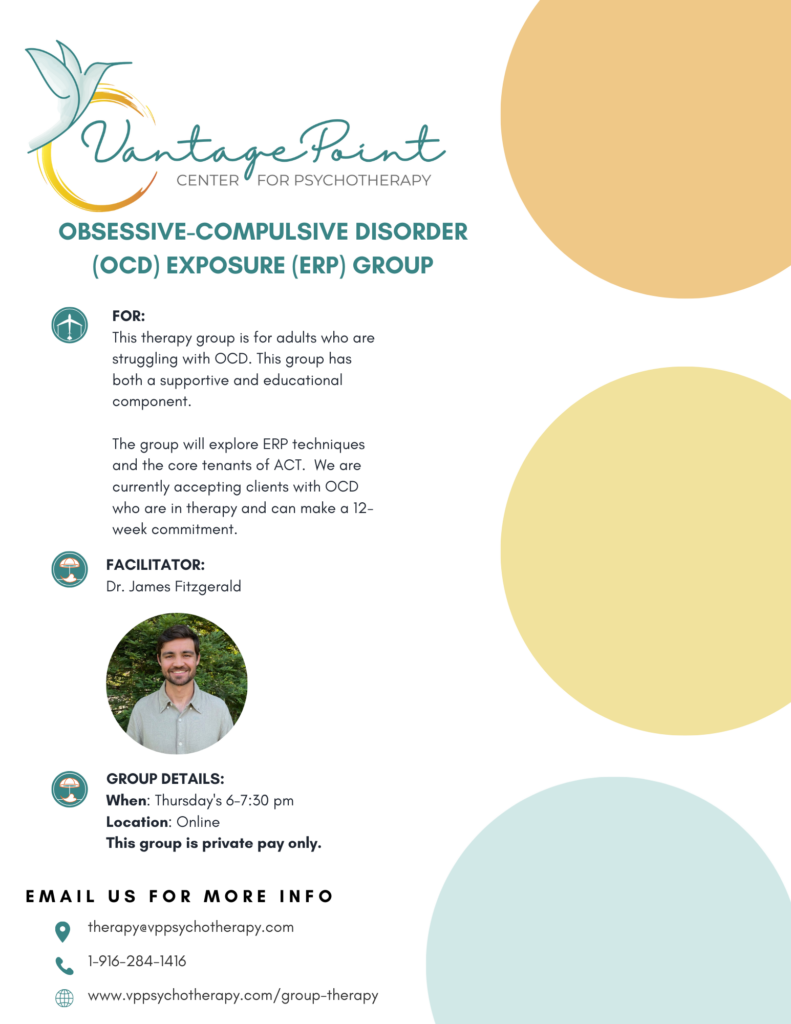
Exposure and Response Prevention (ERP) is the gold-standard, evidence-based treatment for OCD. It works by gradually exposing a person to feared thoughts or situations while helping them resist the urge to engage in compulsions. Over time, the brain learns that anxiety decreases on its own without rituals. ERP has the strongest research support of any OCD treatment and is recommended by the IOCDF and APA.
Does Vantage Point treat all subtypes of OCD?
Yes. Our clinicians have experience with a wide range of OCD presentations, including contamination OCD, harm OCD, religious/scrupulosity OCD, relationship OCD (ROCD), symmetry/order OCD, and Pure-O (primarily obsessional OCD). If you are unsure whether your experience fits OCD, we can help clarify that through the intake and assessment process.
How long does OCD treatment take?
Most clients begin to see meaningful improvement within 12 to 20 sessions of ERP-based therapy, though this varies depending on OCD subtype, severity, and how long symptoms have been present. Some clients continue treatment longer to address additional themes or to work on relapse prevention.
Is Vantage Point an APA-accredited practice?
Yes. Vantage Point Center for Psychotherapy is the only non-academic APA-accredited psychology internship training site in the greater Sacramento area. This means all clinical work is conducted under rigorous supervision that meets national APA standards for psychological practice and ethics.
Do you offer OCD treatment in Spanish?
Yes. We have Spanish-speaking clinicians available for clients who prefer to receive therapy in Spanish.